
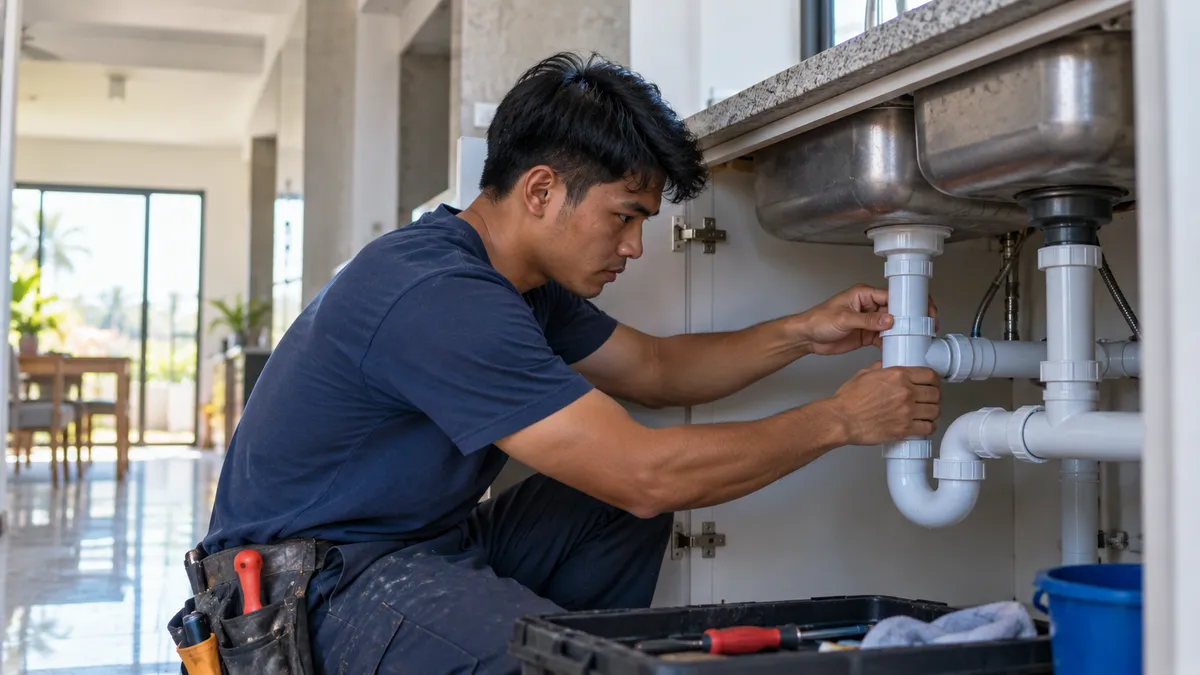
What is the Master Plumbers Licensure Examination?
The Master Plumbers Licensure Examination is the PRC board exam that licenses master plumbers under RA 1378, the Plumbing Law. It is given by the Board of Master Plumbers. A registered master plumber may design, estimate, install and supervise plumbing systems, and sign plumbing plans for building permits.
The exam format
| Licensing body | PRC, Board of Master Plumbers |
|---|---|
| Law | RA 1378 (Plumbing Law, 1955) and the Revised National Plumbing Code (1999) |
| Subject weights | Plumbing Arithmetic 10%, Sanitation, Plumbing Design and Installation 40%, Plumbing Code 10%, Practical Problems 40% (PRC 2025 and 2026 programmes) |
| To qualify | At least 21, Filipino, high school graduate, with five years of plumbing work under a registered master plumber (RA 1378, Sec. 12) |
| Pass mark | Not stated in RA 1378 or the programmes we checked; confirm with the PRC |
| Recent sitting | July 2026: 6,237 examinees, with a pass count of 4,907 |
What the exam covers
- Plumbing arithmetic: unit conversions, volumes, slopes, offsets, pressure and flow.
- The plumbing code: permits, traps and trap seals, cleanouts, fixtures and the basic principles of plumbing.
- Water supply: backflow and cross-connections, air gaps, valves, water hammer, water heaters and pipe materials.
- Drainage, waste and vent: slopes, fittings, fixture units, the kinds of vents and testing.
- Sanitation and wastewater: septic tanks, sewers, grease traps and the Code on Sanitation.
- Plumbing design and installation: joining methods, supports, sleeves, rough-ins and pumped systems.
- Practical problems: tank sizing, pump power, heating, pressure and drainage computations.
Free official resources, and what we add
The PRC publishes the examination programme and results, and RA 1378, PD 856 and PD 1096 are free on lawphil.net. There is no official question bank. We add 102 original practice questions written and checked against those laws and the National Plumbing Code, with every computation worked out step by step.
How to prepare
- Study the basic principles and definitions in the National Plumbing Code: traps, vents, drains and backflow protection come up again and again.
- Read Chapter XVII of the Code on Sanitation (PD 856) on sewage and septic tanks, and the water supply chapter.
- Practise the arithmetic daily: volumes, slopes, pressure head, flow and pump power. Practical problems carry 40% of the weight.
- Take a timed mock exam, then review each wrong answer and its source.
- Before the exam, go back over trap seals, air gaps, vent types and test pressures.
Practice questions with answers
Tap a question to see the correct answer and explanation.
A pipe size is given as 2 inches. What is that in millimetres?
- 5.08 mm
- 50.8 mm
- 20 mm
- 60.0 mm
Answer: B, 50.8 mm. 1 inch = 25.4 mm exactly. 2 x 25.4 = 50.8 mm. In practice this nominal size is often called 50 mm. Source: plumbing arithmetic (unit conversion, 1 in = 25.4 mm).
Which of these traps is prohibited by the plumbing code?
- A P-trap with a proper vent
- A full S-trap
- A trap with a cleanout plug at its base
- A trap integral with a water closet
Answer: B, A full S-trap. The code prohibits full S-traps, bell traps, crown-vented traps and traps that depend on moving parts for their seal, because they siphon easily or clog. A vented P-trap and the trap built into a water closet are standard. Source: Revised National Plumbing Code of the Philippines (1999), chapter on traps and interceptors.
What causes back-siphonage in a water supply system?
- A pressure in the drainage system higher than in the supply
- Water hammer from quick-closing valves
- A negative or sub-atmospheric pressure in the supply piping
- Too large a trap seal on the fixture
Answer: C, A negative or sub-atmospheric pressure in the supply piping. Back-siphonage is backflow caused by negative (sub-atmospheric) pressure in the supply line, for example when a main breaks or a fire pump draws heavily, which can pull dirty water from a fixture back into the supply. Backpressure backflow, by contrast, happens when downstream pressure exceeds supply pressure. Source: Revised National Plumbing Code of the Philippines (1999), chapter on water supply (backflow prevention).