
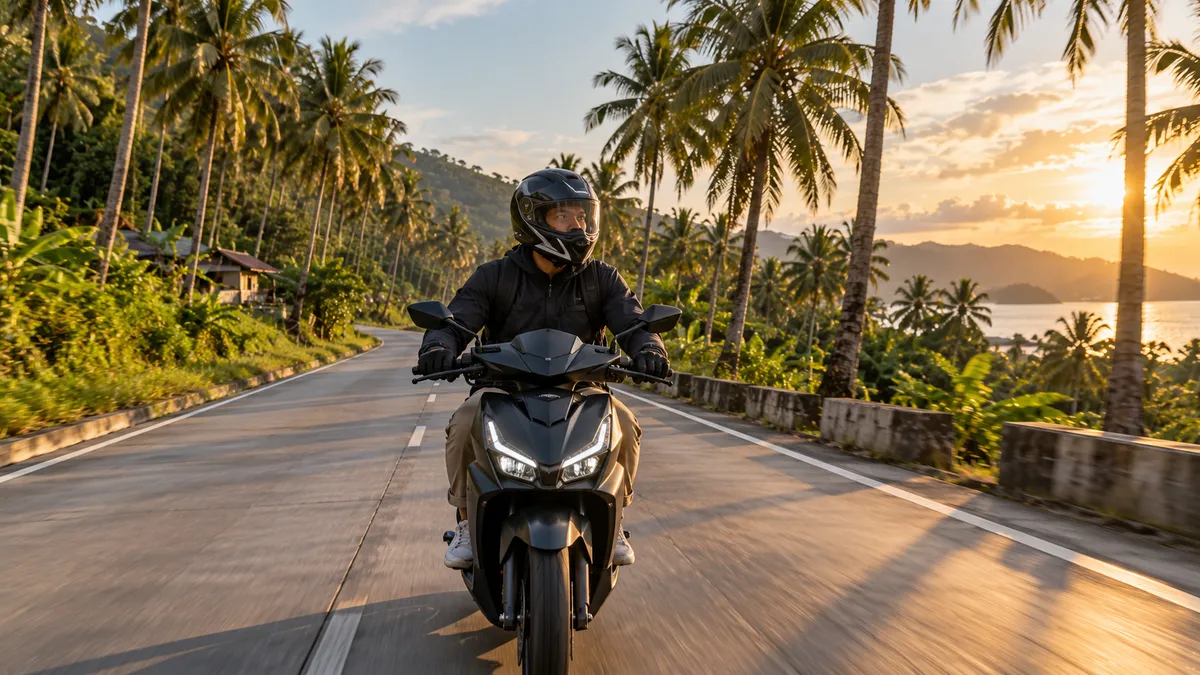
What is the LTO motorcycle exam?
The LTO motorcycle exam is the written (theoretical) test taken at a Land Transportation Office district office by applicants for a driver's license with DL code A (motorcycles) or A1 (tricycles). It is the same LTO theoretical exam as for cars, with questions on motorcycle rules, helmets and child passengers, followed by a practical riding test.
The exam format
| Who takes it | Student permit holders applying for a licence with code A or A1 |
|---|---|
| Before the exam | 15-hour Theoretical Driving Course (for the student permit) and 8-hour Practical Driving Course for motorcycles |
| Number of items | 40 multiple-choice items for a non-professional licence (commonly reported) |
| Pass mark | 30 correct out of 40 (commonly reported) |
| Format | Automated theoretical exam at the LTO, then a practical riding test (LTO Citizen's Charter) |
| Time limit | Not published by the LTO. Our timed mock gives you 45 minutes for 40 questions. |
The item count and pass mark come from an older LTO circular and are widely repeated. Confirm the current format at your LTO district office. Riding a motorcycle for hire needs a professional licence, which has a longer exam.
What the exam covers
- Traffic signs and markings: prohibitory, mandatory, warning and guide signs, centre lines and traffic signals.
- Motorcycle road rules and lane use: speed limits, keeping right, overtaking, sidewalks, lights, hand signals and the 400cc expressway rule.
- Helmet and protective gear: RA 10054 rules for riders and back riders, the PS mark and ICC sticker, fines and the tricycle exemption.
- Child passengers, passengers and loads: the three RA 10666 conditions, the 60 km/h roads rule, fines, and carrying passengers and cargo safely.
- Safe riding techniques: braking, cornering, lane position, following distance and blind spots of large vehicles.
- Hazard perception and weather: wet paint and metal covers, the first rain, crosswinds, doors opening, flooded roads and night riding.
- Licensing, restriction codes and penalties: DL codes A and A1, licence validity, drunk and distracted riding penalties.
- Motorcycle maintenance checks: BLOWBAGETS, chain, tyres, brakes, lights, horn and muffler rules.
Free official resources, and what we add
The LTO publishes the Filipino Drivers Manual, and LTO Administrative Order AVT-2015-029 requires that a reviewer of possible exam questions be given to applicants free. RA 4136, RA 10054 and RA 10666 are free to read on lawphil.net.
What we add: 102 original motorcycle-focused questions sorted by topic, a timed 40-question mock exam, and an explanation for every answer that names the law section or manual chapter it comes from.
How to prepare
- Complete your Theoretical Driving Course and the motorcycle Practical Driving Course.
- Learn the sign families by shape and colour, and the pavement markings that control overtaking.
- Know RA 10054 well: both rider and back rider wear a PS or ICC-marked helmet on every trip; fines run from P1,500 to P10,000 plus licence confiscation.
- Learn the three RA 10666 conditions for carrying a child: feet reach the foot pegs, arms reach around your waist, and a standard helmet.
- Practise one topic at a time, then take timed mocks until you score well above 30 out of 40.
- Review each explanation for the questions you miss and look up the law section it cites.
Practice questions with answers
Tap a question to see the correct answer and explanation.
An eight-sided red sign with the word STOP is at the end of your street. What must you do on your motorcycle?
- Slow down and roll through if the road looks clear
- Stop only when cars are coming from the right side
- Stop fully at the line and go when it is safe
- Put one foot down without stopping
Answer: C, Stop fully at the line and go when it is safe. The STOP sign requires a complete stop, even on a motorcycle, before yielding to traffic on the main road. Source: LTO Filipino Drivers Manual, regulatory signs; RA 4136, Sec. 43(c).
Under RA 4136, what is the top speed for a motorcycle on an open country road with no blind corners?
- 50 km/h
- 60 km/h, lower than cars
- 100 km/h
- 80 km/h
Answer: D, 80 km/h. Sec. 35(b) gives motorcycles the same limit as passenger cars: 80 km/h on open country roads with no blind corners, not closely bordered by houses. Source: RA 4136, Sec. 35(b).
Under RA 10054, who is exempt from the mandatory helmet rule?
- Riders going less than 1 km
- Back riders under 18
- Riders on barangay roads
- Tricycle drivers
Answer: D, Tricycle drivers. RA 10054, Sec. 4 exempts drivers of tricycles from the mandatory helmet requirement. There is no exemption for short trips or minor roads. Source: RA 10054, Sec. 4.