
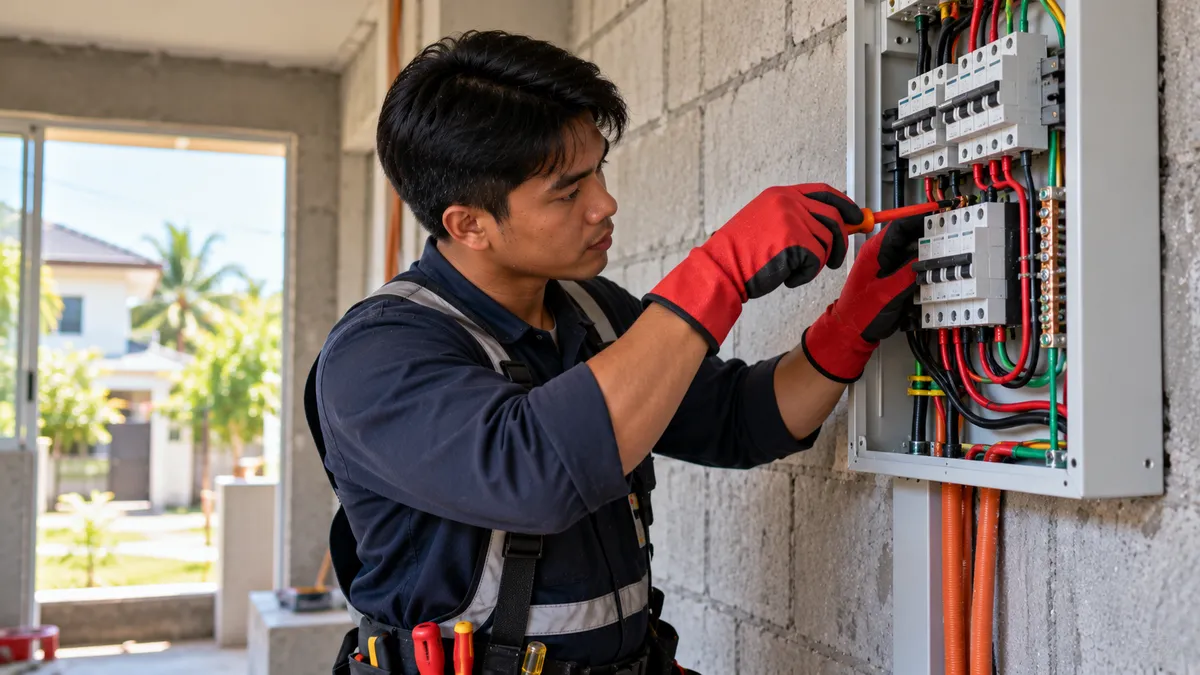
What is the Registered Master Electrician exam?
The RME exam is the PRC board exam for master electricians under RA 7920, the New Electrical Engineering Law. It is given by the Board of Electrical Engineering, usually twice a year. A registered master electrician may install, operate and maintain electrical systems up to 500 kVA and 600 volts.
The exam format
| Licensing body | PRC, Board of Electrical Engineering |
|---|---|
| Law | RA 7920 (New Electrical Engineering Law, 1995) |
| Subjects | Technical subjects 50% and the Philippine Electrical Code Parts 1 and 2 50%, in one day (RA 7920, Sec. 19) |
| To pass | General average of 70%, with no subject below 50% |
| Who may take it | Filipino, at least 18, of good reputation, with one of the electrical training and experience routes in RA 7920, Sec. 18 |
| Recent sitting | April 2026: 882 examinees, with a pass count of 493 |
What the exam covers
- Basic electricity: Ohm's law, series and parallel circuits, power, energy, reactance, impedance, power factor and three-phase circuits.
- Electrical machines and motor control: induction motors, transformers, starters, interlocks and holding circuits.
- Components, tools and test equipment: meters, meggers, clamp meters, resistors, capacitors and diodes.
- Maintenance, troubleshooting and RA 7920.
- PEC general requirements: working space, continuous loads, voltage drop, receptacle spacing and ampacity adjustment.
- PEC wiring methods and materials: conduit fill, bends, colour coding, conductor insulation and raceways.
- PEC panelboards, overcurrent protection and grounding: motor circuit sizing, GFCIs, electrodes and bonding.
- PEC special locations and symbols: hazardous locations, emergency systems, pools and plan symbols.
Free official resources, and what we add
The PRC publishes the examination programme and results, and RA 7920 is free on lawphil.net. The Philippine Electrical Code is published by the Institute of Integrated Electrical Engineers. There is no official question bank. We add 107 original practice questions written and checked against RA 7920 and the PEC, with every calculation worked out step by step.
How to prepare
- Drill the formulas until they are automatic: Ohm's law, power, reactance, impedance, three-phase power, slip and transformer currents.
- Learn the PEC rules that come with numbers: 125% for continuous loads and motor conductors, 250% for inverse time breakers, 40% conduit fill, 900 mm working space.
- Read RA 7920 for the Board, the RME scope, qualifications, passing rules and penalties.
- Take a timed mock exam and review every wrong answer with its source.
- Balance your time: the PEC is half the exam.
Practice questions with answers
Tap a question to see the correct answer and explanation.
An electric kettle draws 10 A from a 230 V outlet. What is its power?
- 23 W
- 220 W
- 2,300 W
- 23,000 W
Answer: C, 2,300 W. P = V x I = 230 x 10 = 2,300 W (2.3 kW). Source: power formula P = VI.
A 4-pole, 60 Hz induction motor runs at 1,750 rpm at full load. What is the slip?
- About 5.0%
- About 2.8%
- About 2.9%
- About 0.28%
Answer: B, About 2.8%. Slip = (Ns - N) / Ns x 100 = (1,800 - 1,750) / 1,800 x 100 = 2.78%, about 2.8%. Dividing by 1,750 gives 2.86% (2.9%), which uses the wrong base. Source: slip formula s = (Ns - N) / Ns.
Which instrument lets you measure the current in a live conductor without opening the circuit?
- A megger
- A clamp-on ammeter
- An ohmmeter
- A voltage tester pen
Answer: B, A clamp-on ammeter. A clamp meter senses the magnetic field around a single conductor, so it reads current without breaking the circuit. Clamping around both line and neutral reads zero because their fields cancel. Source: electrical test equipment practice.